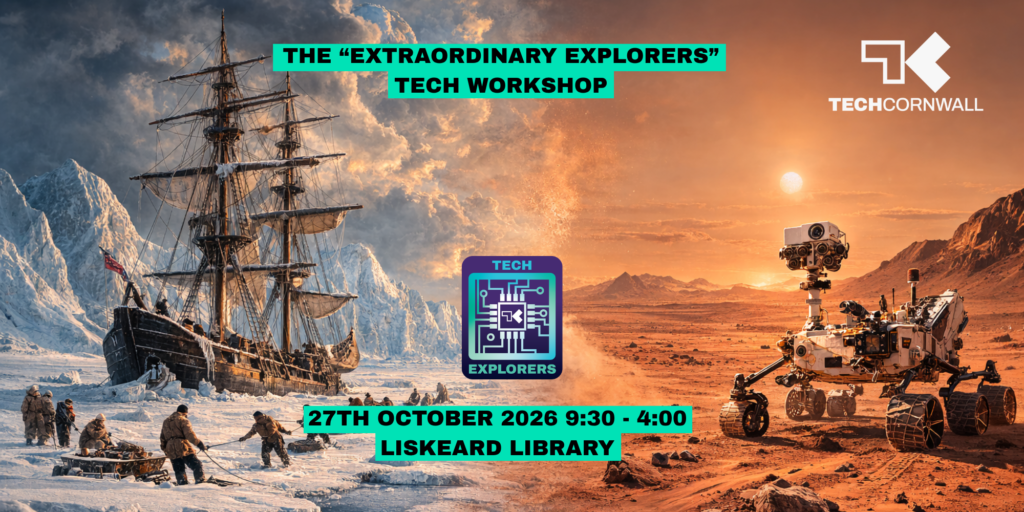
From Arctic ice to the Red Planet
9:30am – 4:30pm, Liskeard Library – 27th October 2026
Two true stories of exploration, 170 years and 140 million miles apart, meet in one Liskeard classroom, and your child helps write the code for both.
In the 1850s, a Liskeard man named George Lower sailed into the Arctic aboard HMS Resolute, searching for the lost Franklin expedition. If an explorer went down out there, there was no way to call for help — no signal, no rescue, nothing but ice and silence.
This workshop asks a simple question: what if George Lower had a micro:bit? Over one morning, students build the device that could have saved him — then discover it’s the same problem NASA solves every day, 140 million miles away, where a Mars rover can’t wait for instructions from home either.
Built around this summer’s Library Reading Challenge, Extraordinary Explorers, the session turns a local history story into two hands-on coding builds — no experience needed, all equipment provided.
PART 1 – THE RESOLUTE RESCUE
A distress signal, 170 years overdue
Local history · wearable tech
Students meet George Lower and HMS Resolute’s search through the Arctic ice for the lost Franklin expedition — and the impossible problem explorers faced once they were out of sight: no way to call for help.
THE BUILD: SMART BEACON
Working in Python on a micro:bit, students program a wearable that uses the onboard accelerometer to detect a fall. If the wearer doesn’t cancel the alarm in time, the beacon automatically broadcasts a radio distress signal to a base station — the rescue call George Lower never had.
PART 2 – THE MARS FRONTIER
Robotics · autonomous systems
Local history · wearable tech
The story jumps to today’s extraordinary explorers: robotic rovers crossing the Martian surface. A radio message between Earth and Mars can take over twenty minutes each way — so a rover has to read the terrain and make its own calls, with no one on Earth able to step in.
THE BUILD: AUTONOMOUS ROVER
Students program a Raspberry Pi–powered rover in Python, working up to the same motor-control logic behind commands sent to real missions like Perseverance and Curiosity — driving, sensing, and deciding, one line of code at a time.
Why we built it this way
Closes the KS3 gap
This is the age where coding turns theoretical and kids drift from STEM. Real hardware in their hands keeps it tangible.
Beyond the screen
Micro:bits and Pi-powered rovers move students past screen-based games into genuine hardware engineering.
A local hero, reclaimed
George Lower’s story shows students that Liskeard has always been part of the story of global exploration.
Reading challenge ties
Built around the Library’s own “Extraordinary Explorers” theme, bringing this summer’s reading to life through code.
**PLEASE NOTE**
Places are funded by the Lyskerrys Fund, with fully funded spots reserved for children living in the Caradon District. Spaces are limited — booking secures your child’s seat at no cost.
The signal’s waiting to be sent.
One morning, two missions, a rover and a beacon your child builds themselves. Places are limited and funded — reserve one before the countdown starts.

