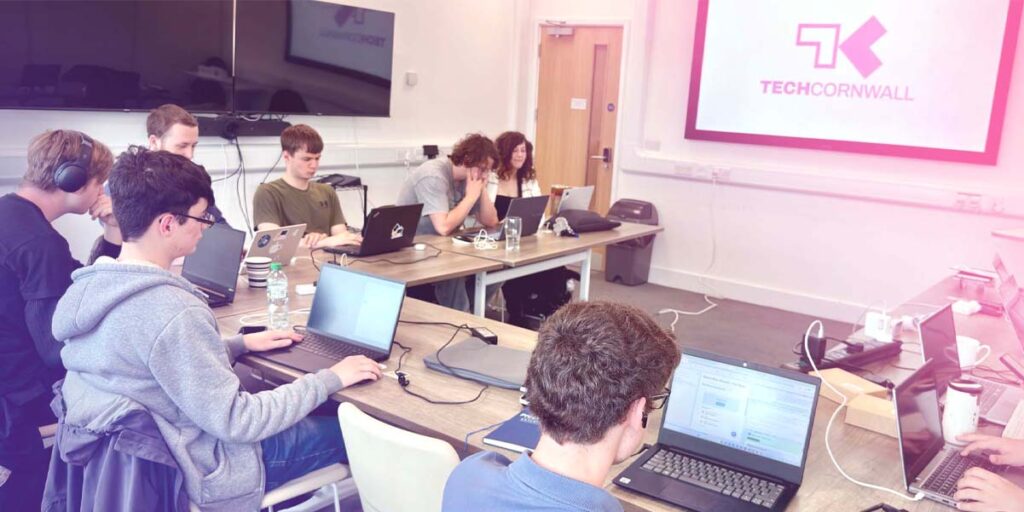
At the end of September, students from City College Plymouth will start their T-Level industry placements with Tech Cornwall. They will be with us for 2 days a week through to the end of November, and we have a fairly significant challenge ahead of us.
We need to find them some good problems to solve.
The students are studying Digital Production, Design and Development they need to be working on real projects for real organisations. That means we are looking for businesses and organisations across Cornwall that have a digital idea, problem or opportunity they would be willing to put in front of them.
You certainly do not need to be a technology company to get involved. In fact, some of the most interesting projects can come from businesses that do something completely different but have spotted somewhere that technology might help.
Perhaps there is a small internal tool that would make life easier for your team. Maybe you have some data that you collect but do very little with. There might be a repetitive process that you have wondered about automating, an idea for a web application, something on your existing website that could work better, or simply an idea that has been sitting on the company wish list because nobody has had the time to explore it.
That is the sort of thing we would like to hear about.
We are not expecting businesses to arrive with a detailed technical specification. You do not even need to know what the eventual solution should look like. Come to us with the idea or the problem and we can talk it through with you and work out whether it could become a suitable project for the students.
We know this can work
This will be the fourth year Tech Cornwall has supported T-Level students with their industry placements. Over the previous three years we have worked with 21 students, with businesses providing the real world projects for them to tackle.
Those projects have been remarkably varied. Students have worked on chatbots, rebuilt an intranet website, developed a patent and intellectual property dashboard, created a privacy policy description tool, built a deliberately vulnerable website for cyber security testing and developed a careers and job discovery website.
Some have gone considerably further than simply providing something for a student portfolio.
JamUp provided one of our students with a chatbot project. They messaged us once the students had finished:
“We have got the chatbot working that you created for your T Level project… We are so pleased!”
That is a pretty good outcome for something that started life as a student placement project.
Flann Microwave gave two students the challenge re-engineering their intranet site. Sarah Deacon from Flann told us she was impressed by their willingness to work through problems themselves rather than constantly asking for the answer, and by how well they communicated what they needed from the business. Most importantly, they ultimately produced a functioning website.
“A great experience helping to support potential junior developers gain some work skills as they start deciding their future ambitions.”
That is exactly the relationship we are trying to create.
The business becomes the client
There is an important difference with the way we run these placements. Normally, offering a T Level industry placement means bringing a student into your workplace and taking responsibility for supervising them. But the students will work from within City College Plymouth, where Tech Cornwall will host and support them throughout their placement.
The business provides the project and becomes the client.
If the students do not understand something, they will reach out to ask you. As the work develops, they will need feedback on what they have done. Your inputs will guide and redirect the work as it is created.
The experience has been one of the things previous students have valued.
“I would 100% agree that my work experience at Tech Cornwall has prepared me for the workplace and has improved my knowledge.”
How much does the business need to do?
For the business, the commitment can be relatively light.
We would expect you to help the students understand the problem, respond to occasional questions, review their progress and tell them whether what they are developing is actually meeting your needs. Most of that can happen through email and occasional video calls.
Tech Cornwall takes responsibility for the day to day supervision and support of the students.
If you want to become more involved, however, we certainly will not stop you. Meeting the students, showing them your organisation, discussing your industry or simply spending some time talking about careers can add enormously to their experience. Some of the strongest relationships we have seen have developed when a business has become genuinely interested in what its students are doing.
IntSpired provided two previous students with a cyber security project that involved building a web application as a live testing target. At the end of their time together, founder Keith Lloyd told the students that their work had “fed directly into real projects” and added that he would “absolutely be interested in coming back next year” to support more students.
That is the sort of connection we hope these placements will continue to create.
What will you get at the end?
We do need to be realistic about what businesses should expect.
These are second year T Level students, generally aged 17 or 18, not experienced software developers. Their technical knowledge and confidence will vary. So we cannot promise that giving us an idea in September will result in a polished commercial product appearing at the end of November. It is the opportunity for a student to work on a real work project for a business that wants to support the new generation.
A successful outcome might be a working application. It could equally be a prototype or proof of concept that demonstrates what is possible and gives the business something it can develop further. Sometimes a project might not reach completion at all. That does not necessarily mean it has failed. The experience counts.
One previous business whose students were unable to complete their project still came back to us saying that they had been “really great to work with” and offered further support if the students wanted to continue developing what they had started.
We are going to need quite a few ideas
With 18 students joining us and no more than two students allowed to work on each project, we need at least nine projects simply to get everybody started.
In reality, we need considerably more.
We want students to have some choice over the projects that interest them rather than simply being allocated whatever happens to be available. Some projects may be completed relatively quickly too, leaving students ready to take on another challenge before their placement finishes. So we would like to build up a really good bank of projects from businesses and organisations across Cornwall, and we will continue accepting ideas throughout the placement into November.
Digital skills are needed throughout modern industry. A student project could come from manufacturing, engineering, marine, creative industries, environmental organisations, charities, professional services or almost anywhere else. A business does not need to think of itself as a digital business to have a problem that might benefit from a digital solution.
For a young person, working on one of those problems changes the context of what they are learning. Suddenly the code is not being written because somebody at college has told them to write it. Someone actually wants the thing at the other end. And for the business, there is the chance to meet some of the people who could become part of our future workforce.
So have a think about your own organisation.
Is there a digital problem you keep working around rather than solving? An idea somebody suggested months ago that nobody has found time to investigate? Something useful you would explore if only there were a few more hours in the week? Tell us about it.
You do not need to write a project brief. You do not need to know which technology should be used and there is no commitment simply by getting in touch. Give us the idea and we can talk it through with you and see whether we can turn it into an achievable real world project for one or two of our T-Level students.
It could give your organisation the chance to explore an idea that has been sitting on the wish list.
For the students, it could be the first piece of work they ever produce that somebody genuinely needs.
Got an idea? We would love to hear about it.
